


How the Cincinnati & Hamilton County Public Library Strengthens Our Regional Economy
When we talk about economic competitiveness in Greater Cincinnati, the conversation often centers on corporate relocations, major investments, and job growth.
But long-term regional prosperity depends on something deeper: strong civic infrastructure that develops talent, expands access to opportunity, and supports innovation at every level.
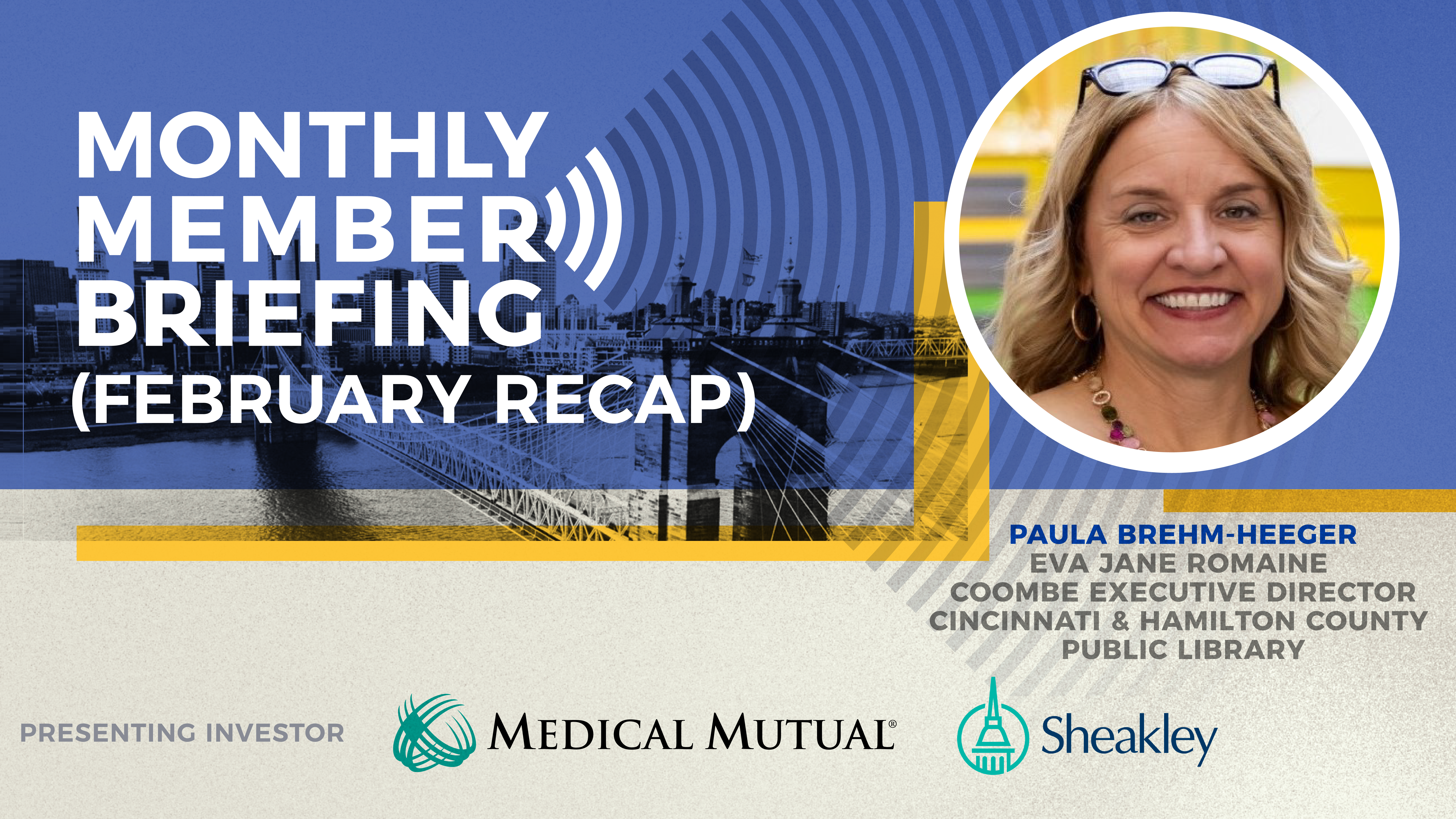
That is exactly the role being played by the Cincinnati & Hamilton County Public Library under the leadership of Paula Brehm-Heeger, the Eva Jane Romaine Coombe Executive Director.
At a time when Cincinnati is growing its national profile and attracting new investment, the library system stands as one of the region’s most powerful — and often underestimated — economic engines.
Scale, Reach, and Regional Impact
Serving more than 800,000 residents across Hamilton County, the library system includes 40 branch libraries, a downtown Main Library, and more than one million square feet of public space.
Last year alone, the system recorded:
4.3 million visits
19+ million items checked out
370,000+ program participants
As Brehm-Heeger noted, the system is far from a quiet institution:
“We are a real service anchor for the entire region and our county… We are a library that punches above our weight.”
From a Chamber perspective, that scale matters. Institutions that reach across neighborhoods and demographics create the shared foundation necessary for a strong, inclusive economy.
Each branch operates as a neighborhood hub — a trusted space for gathering, learning, and connection. As Chamber President & CEO Brendan Call reflected:
“Each one of these places has a role in its own micro community or neighborhood and as a gathering space… that place means a great deal to them.”
Strong neighborhoods support strong talent pipelines. Strong talent pipelines fuel strong employers.
Building the Talent Pipeline Early and Often
Economic growth depends on workforce readiness, and workforce readiness begins with literacy.
The library’s early childhood and K–12 programming includes:
180,000+ storytime participants annually
41,000 free books distributed through Summer Reading
12,000 homework help sessions
These programs help prevent learning loss and ensure that every child — regardless of zip code — has access to foundational reading skills.
The impact extends well beyond childhood. For adult learners and job seekers, the library provides GED preparation, FAFSA assistance, career workshops, job fairs, and self-paced learning platforms.
“Information literacy is just increasingly important,” Brehm-Heeger emphasized. “People want a place to come together.”
For employers facing workforce shortages, these services represent more than community programming — they are direct investments in economic mobility and employability.
Innovation Without Barriers: Makerspaces and Entrepreneurship
One of the clearest intersections between the library and the business community is its network of six makerspaces, including the recently refreshed space at the Main Library and the next-generation Forest Park branch.
These makerspaces provide free access (with a library card) to:
3D printers
Laser engravers
Vinyl cutters and printers
Audio and video production equipment
Professional-grade design software
Materials are sold at cost, creating what library leaders describe as a low-risk, low-cost environment for experimentation.
In practical terms, this means early-stage entrepreneurs can prototype products, test branding ideas, and build skills without significant upfront capital.
One local business owner used the vinyl equipment and staff support to launch Commercial Wraps LLC — turning curiosity and experimentation into a growing enterprise.
For the Chamber, this model aligns directly with our commitment to supporting small businesses, encouraging innovation, and lowering barriers to entry for new entrepreneurs.
Meeting Space as Business Infrastructure
Modern economic participation requires professional space — whether for client meetings, collaboration, or study.
Through its 2018–2028 Facilities Master Plan, the library has added more than 60,000 square feet of new public space, much of it dedicated to study and meeting rooms.
Last year, those rooms were booked nearly 79,000 times.
For small businesses, remote workers, startups, and nonprofits, these rooms provide professional infrastructure without overhead costs — strengthening productivity and connectivity across the region.
This is civic infrastructure functioning as economic infrastructure.
Revitalizing Neighborhoods Through Smart Investment
The library’s facilities strategy also supports neighborhood vitality and commercial reinvestment.
Recent projects include:
Renovation of the historic Walnut Hills Carnegie branch
Integration of the Madisonville branch into mixed-use development
Conversion of former retail spaces in Mount Healthy and Deer Park into high-traffic civic anchors
A major renovation of the Main Library downtown
“Using tired retail for something like a public library has been so successful,” Brehm-Heeger noted of the Deer Park location, now serving as an anchor for its shopping center.
These projects increase neighborhood attractiveness for residents, employers, and talent alike — reinforcing the Chamber’s belief that strong communities underpin strong economies.
Digital Leadership in a Changing World
Far from being displaced by technology, the library is leading in digital engagement.
In 2025, the system recorded:
6 million Libby downloads
7 million total e-material downloads
That performance places the library among the top systems nationally and #1 in Ohio for digital usage.
“Those are new users,” Brehm-Heeger explained. “People engaging with the public library to start a different kind of relationship to reading and learning.”
As artificial intelligence and digital tools reshape the workforce, the library continues to serve as a trusted guide in information literacy and technology navigation.
“We’re an incredibly adaptable institution,” she said. “The focus is still the same: literacy, learning, lifelong learning.”
A Strategic Partner in Regional Prosperity
From the Chamber’s perspective, the Cincinnati & Hamilton County Public Library is not simply a cultural asset. It is a strategic partner in building a competitive and inclusive regional economy.
It strengthens early literacy and workforce readiness.
It supports entrepreneurs and small businesses.
It provides essential meeting and innovation infrastructure.
It anchors neighborhood revitalization.
It expands access to digital tools and lifelong learning.
Economic growth is not sustained by private investment alone. It requires trusted institutions that connect people to opportunity at every stage of life.
As Cincinnati continues to compete nationally for talent, capital, and innovation, the library remains one of the region’s most powerful — and reliable — engines of upward mobility.
The Chamber is proud to stand alongside Paula Brehm-Heeger and her team as we work together to ensure that opportunity in Hamilton County is not only growing — but accessible to all.